Table of Contents
- Why Chicago Winters Are Especially Hard on Suburban Roofs
- Common Cold-Weather Roof Failures We See Across the Suburbs
- What Makes a Roofing Material Truly Weather-Resistant
- Our Premium DaVinci Slate and Shake Solutions for Ice and Snow
- Underlayment, Ventilation, and Ice Dam Defense Layers We Install
- How Our 35+ Years of Local Expertise Shapes Every Winter-Ready Installation
- 24/7 Emergency Roofing Support When Storms Strike
- Working With Our Licensed Public Insurance Adjusters After Winter Damage
- Scheduling Your Pre-Winter Roof Assessment With Owen Enterprises
- Frequently Asked Questions (FAQ)
Why Chicago Winters Are Especially Hard on Suburban Roofs
Chicago winters punish roofs in ways homeowners in milder climates rarely see. We deal with freeze-thaw cycles that can swing 40 degrees in a single day, lake-effect snow that piles up faster than gutters can drain, and ice storms that coat shingles with hundreds of pounds of extra weight. Add winds gusting off Lake Michigan and you have a roof system under near-constant stress from November through March.
The suburbs add their own wrinkles. Mature tree canopies in Naperville, Hinsdale, and the North Shore drop debris that traps moisture against shingles. Older homes in Oak Park and Evanston often have undersized soffit vents and shallow attic insulation, which sets the stage for ice dams. If you own a home in these areas, weather-resistant roofing materials are not a luxury, they are the baseline standard.
Quick takeaway: If your roof is more than 15 years old and has not been inspected since last spring, schedule a look before the first hard freeze.
Common Cold-Weather Roof Failures We See Across the Suburbs
After more than three decades of winter call-outs, the same failures repeat across the region:
- Ice dams at eaves that force meltwater back under shingles and into ceilings.
- Cracked or shattered shingles from rapid freeze-thaw cycling, especially on asphalt systems past year 12.
- Lifted or missing shingles after high-wind events along open suburban lots.
- Flashing failures at chimneys, skylights, and sidewalls where caulk has gone brittle.
- Sagging gutters pulled away from fascia by the weight of frozen runoff.
- Attic condensation that mimics a roof leak but actually stems from ventilation issues.
Each of these failures is preventable with the right materials, the right install details, and a maintenance rhythm tuned to Chicago’s climate. The homes we revisit year after year are almost always the ones where one of those three pieces was skipped.
What Makes a Roofing Material Truly Weather-Resistant

Not every product marketed for cold climates earns the label. When we evaluate durable roofing for cold climates, we look at five performance traits:
- Impact resistance. A Class 4 rating means the material can take hail and ice without fracturing.
- Thermal stability. The material should expand and contract minimally as temperatures swing.
- Wind uplift rating. We want products tested to at least 110 mph, ideally higher for exposed lots.
- Water shedding profile. Steeper, interlocking, or layered designs move meltwater off the deck faster.
- UV and freeze-thaw longevity. A 50-year material that still looks new at year 20 is doing its job.
Asphalt shingles can meet some of these targets, but synthetic slate and shake products consistently outperform them across every category. That performance gap is exactly why we recommend premium synthetics for homeowners who want a roof installed once and forgotten about for decades.
Our Premium DaVinci Slate and Shake Solutions for Ice and Snow
DaVinci composite tiles are engineered polymer products that look like hand-split cedar or quarried slate but behave far better in winter. They carry Class 4 impact ratings, wind ratings up to 110 mph (with enhanced installation methods pushing higher), and a Class A or Class C fire rating depending on the profile.
What makes them a strong fit for snow-resistant roof systems in our market:
- No water absorption. Unlike natural slate or cedar, the tiles do not soak up moisture and crack when it refreezes.
- Color stability. UV inhibitors keep the finish from fading even after years of harsh sun bouncing off snow.
- Dimensional consistency. Tiles lock together cleanly, leaving fewer gaps for wind-driven snow to infiltrate.
- Lighter weight than stone slate. No structural reinforcement required on most suburban framing.
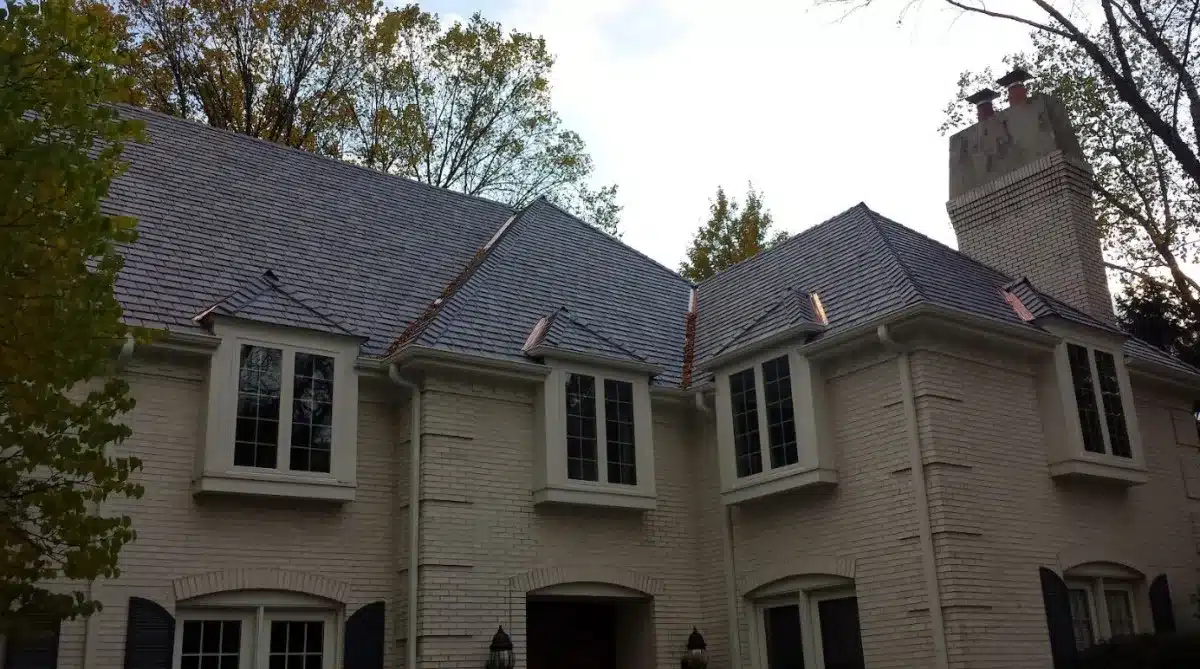
For homeowners weighing a long-horizon investment, our DaVinci slate service pairs the aesthetics of a historic home with the engineering of a modern composite. We have installed these systems across Hinsdale, Wheaton, and Glenview where the homes demanded both curb appeal and serious winter performance.
Underlayment, Ventilation, and Ice Dam Defense Layers We Install
The visible roofing material is only one layer of a winter-ready system. What sits beneath it matters just as much for ice dam prevention.
Our standard winter-ready assembly includes:

- Self-adhering ice and water shield extending at least 6 feet up from the eaves, plus around all penetrations, valleys, and sidewalls. Many Chicago suburbs require 3 feet past the interior wall line, and we routinely exceed code.
- High-performance synthetic underlayment across the rest of the deck for a secondary water barrier.
- Balanced intake and exhaust ventilation using continuous soffit vents paired with ridge vents, sized to the attic volume.
- Properly sealed bath, kitchen, and dryer vents that exit through the roof rather than dumping warm moist air into the attic.
- Drip edge and kick-out flashing at every eave and sidewall termination to direct water away from fascia and siding.
When these layers work together, the roof deck stays cold, snow melts evenly, and meltwater drains off the eaves instead of refreezing into a dam. Skip any one of them and you are gambling with your ceilings.
How Our 35+ Years of Local Expertise Shapes Every Winter-Ready Installation
Roofing in Barrington is not the same as roofing in Berwyn. Pitch, framing era, attic geometry, exposure to lake winds, and even the prevailing tree species all influence how a roof performs in winter. After 35+ years installing residential roofing across the greater Chicago suburbs, we have built a working knowledge of these local variables that no out-of-state contractor can match.
That experience shows up in small but critical decisions: how far we extend ice shield on a low-slope porch roof, how we detail a flashing transition on a 1920s Tudor, which fastener pattern we use on an exposed cul-de-sac home in Naperville. Those details are the difference between a roof that survives 30 winters and one that fails in 10.
24/7 Emergency Roofing Support When Storms Strike
Winter does not wait for business hours. When an ice storm rips off shingles at 2 a.m. or a tree limb punches through the deck during a January thaw, our 24/7 emergency response team is on call.
What our emergency service includes:
- Rapid tarping and temporary weatherproofing to stop interior damage immediately.
- Damage documentation with photos and measurements you can share with your insurer.
- Priority scheduling for permanent repairs once conditions allow.
Save our number now. The worst time to find an emergency roofer is while water is dripping onto your hardwood floors.
Working With Our Licensed Public Insurance Adjusters After Winter Damage

Filing a winter storm claim is rarely simple. Carriers may underestimate damage, exclude certain causes, or push for partial repairs when a full replacement is warranted. We carry licensed public insurance adjusters on staff, which puts a credentialed advocate on your side of the table.
Here is how we typically guide homeowners through a claim:
- Inspection and scoping. We document every affected component, from shingles to flashing to interior staining.
- Claim preparation. We translate the damage into the language and line items insurers respect.
- Adjuster meetings. We attend the carrier’s inspection so nothing gets missed or minimized.
- Settlement review. We make sure the payout actually covers a code-compliant, weather-resistant rebuild.
This combination of contractor and licensed adjuster under one roof is uncommon in our industry, and it routinely produces better outcomes for homeowners after a major storm.
Scheduling Your Pre-Winter Roof Assessment With Owen Enterprises
The best time to address Chicago winter roofing concerns is before the first snowfall. Our pre-winter assessment covers shingle and flashing condition, attic ventilation, insulation depth, gutter alignment, and any vulnerable transitions where ice dams tend to form. You get a written report, prioritized recommendations, and a clear estimate if work is needed.
To schedule, call our office or request an assessment through our website. Whether you are planning a full DaVinci slate installation, replacing aging asphalt with a more durable system, or simply want a trusted set of eyes on a roof that made it through last winter, we are ready to help you head into the cold season with confidence.
Frequently Asked Questions (FAQ)
What makes a roofing material truly weather-resistant for Chicago winters?
A weather-resistant roof needs to handle freeze-thaw cycles, heavy snow loads, ice damming, and high winds without cracking or losing its seal. We look for materials with strong impact ratings, low water absorption, and proven cold-weather performance, which is why we install DaVinci composite slate and shake. We also pair the surface material with the right underlayment, ventilation, and ice barrier system so the entire roof assembly performs as one.
How do we help prevent ice dams on suburban Chicago homes?
We address ice dams at the source by installing self-adhering ice and water shield along the eaves, valleys, and penetrations, then balancing intake and exhaust ventilation to keep attic temperatures consistent. Proper insulation coordination and flashing details also reduce the warm spots that cause snowmelt to refreeze. This layered approach protects the roof deck, gutters, and interior ceilings throughout the winter.
What should homeowners do if winter storm damage hits their roof?
We offer 24/7 emergency roofing support, so the first step is to call us and we will tarp or stabilize the roof to prevent further interior damage. From there, our licensed public insurance adjusters can document the loss, communicate with the insurance carrier, and make sure the claim reflects the full scope of damage. Once the claim is settled, we complete the permanent repair or replacement using winter-rated materials and methods.