Table of Contents
- Preserving Architectural Heritage in Chicago's Historic Suburbs
- Why Traditional Slate and Cedar Shake Fall Short Today
- What Makes DaVinci Slate and Shake the Authentic Choice
- Matching Your Home's Era: Color, Profile, and Pattern Options
- Performance Benefits: Durability, Weather Resistance, and Warranty
- Our Installation Process for Historic Properties
- Complementing Your Roof with Siding, Windows, and Outdoor Living
- Why Homeowners Trust Our 35+ Years of Local Expertise
- Getting Started with a DaVinci Roofing Consultation
- Frequently Asked Questions (FAQ)
Preserving Architectural Heritage in Chicago’s Historic Suburbs
From the Tudor Revivals of Oak Park to the Queen Anne Victorians in Evanston and the Prairie-style estates of Hinsdale, the western and northern Chicago suburbs hold some of the most distinctive residential architecture in the Midwest. These homes were built when natural slate and hand-split cedar were standard materials for roofs, and their rooflines carry as much character as the brickwork and leaded glass below.
Preserving that character in 2026 means making smart choices about replacement materials. Local preservation boards in communities like Riverside and Lake Forest often require roofs that visually match historic profiles, even when modern code and insurance considerations push homeowners toward updated systems. The good news: it is now possible to honor original design intent without inheriting the maintenance burdens of century-old materials.
Quick takeaway: Before you replace a historic roof, check your village’s design review guidelines and confirm acceptable materials. We can help you interpret those requirements during a site visit.
Why Traditional Slate and Cedar Shake Fall Short Today
Authentic quarried slate and hand-split cedar shake are beautiful, but they come with real drawbacks for modern homeowners.
- Weight. A natural slate roof can exceed 1,000 pounds per square. Many older framing systems need structural reinforcement before reroofing, adding thousands to the project.
- Cost and sourcing. Quarried slate prices have climbed steadily, and quality cedar shake supply has tightened.
- Maintenance. Cedar requires regular treatment against rot, moss, and insect damage. In Chicago’s freeze-thaw climate, untreated shakes can fail in 20 to 25 years.
- Fire vulnerability. Untreated cedar carries a poor fire rating, a growing concern for insurers.
- Brittleness. Natural slate cracks underfoot, making repairs after a hailstorm slow and expensive.
For a home you plan to keep for decades, these tradeoffs add up. That is where composite shake shingles and synthetic slate roof systems change the math.
What Makes DaVinci Slate and Shake the Authentic Choice

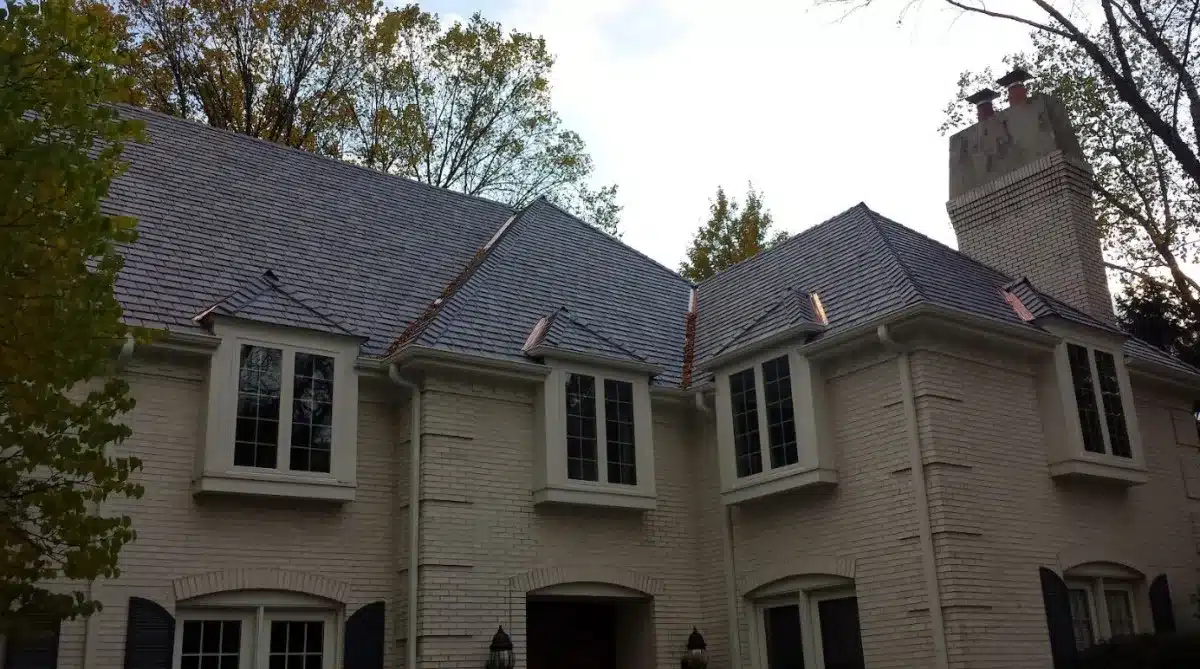
DaVinci Roofscapes manufactures polymer-based tiles engineered to replicate quarried slate and hand-split cedar with remarkable accuracy. Up close, the textures, edge variations, and shadow lines read as the real thing. From the curb, even trained eyes have a hard time telling the difference.
What sets DaVinci slate and shake apart for our historic clients:
- Lightweight construction. Roughly one-quarter the weight of natural slate, so no structural retrofitting in most cases.
- Class A fire rating and Class 4 impact resistance. The highest tiers available, which many insurers reward with premium discounts.
- UV-stable color compounds. The pigments are blended into the polymer, not painted on, so colors hold their depth through decades of sun exposure.
- Authentic dimensions. Tile thicknesses, widths, and tapers match traditional milling specs, preserving the visual rhythm of the original roof.
For homeowners weighing options, our comparison of DaVinci Shake vs cedar walks through the practical tradeoffs in detail.
Matching Your Home’s Era: Color, Profile, and Pattern Options
The right DaVinci profile depends on your home’s architecture and original roofing. A few starting points we use during design consultations:
- Tudor and English Cottage homes typically suit Multi-Width Slate in deep blended tones such as Castle Gray or Slate Black. Staggered widths echo the irregular pattern of historic European roofs.
- Victorian and Queen Anne homes look best with Single-Width Slate, often in stronger color blends that highlight turrets and gables. Smooth color transitions across decorative dormers are easier with synthetic tile.
- Craftsman bungalows and Prairie-style homes call for Bellaforté or Multi-Width Shake in warm browns and weathered grays, capturing the look of aged cedar.
- Colonial Revivals pair well with uniform single-width slate in classic charcoal or black for a clean, formal line.
DaVinci offers stock blends and fully custom color matching. We bring physical samples to your home so you can review them in actual sunlight against your brick, stone, or stucco. Lighting from a showroom rarely tells the truth about how a roof will read against your specific facade.
Actionable tip: Photograph your home at three times of day, morning, midday, and golden hour, before sample selection. It makes color decisions much easier.
Performance Benefits: Durability, Weather Resistance, and Warranty
Chicago suburbs see the full punishment of Midwest weather: ice dams in January, 70 mph straight-line winds in spring, summer hail, and brutal humidity shifts. DaVinci tiles are engineered for exactly this profile.

- 50-year limited lifetime warranty on most product lines, transferable to subsequent owners.
- Wind ratings up to 110 mph when installed to specification.
- Class 4 hail impact resistance, the same rating that qualifies many homes for HO-3 insurance premium reductions in Illinois.
- No moss, mildew, or insect vulnerability, meaning no annual treatments or pressure washing.
- Color retention backed by accelerated UV testing that simulates decades of exposure.
For luxury roofing materials, this combination of authentic appearance and engineered performance is hard to match. A historic home roof replacement should be a once-in-a-generation project, and the warranty period reflects that expectation.
Our Installation Process for Historic Properties
Installing a synthetic slate roof on a historic home is not the same as a standard shingle tear-off. Our crews are factory-trained on DaVinci systems, and we follow a sequence built around protecting original features.
- Pre-installation assessment. We inspect framing, decking, flashing, gutters, and any masonry adjacent to the roof. Older homes often hide soft decking or undersized chimney flashing.
- Documentation and permits. We pull required permits and coordinate with local historic review boards when applicable.
- Tear-off and deck repair. Old materials are removed in controlled sections to protect landscaping, copper gutters, and slate walkways below.
- Underlayment and ice-and-water shield. We install high-temperature synthetic underlayment and extend ice barrier well past code minimums on north-facing slopes and valleys.
- Flashing upgrades. Copper or pre-finished metal flashing is fabricated to match the era of the home.
- Tile installation. Each course is set to manufacturer pattern specs, with intentional color blending across the roof plane.
- Final walkthrough. We review the installation with you and provide warranty registration.
If storm damage triggered your project, our licensed public insurance adjusters can manage the claim from inspection to final settlement, ensuring the scope reflects the true cost of a like-kind historic restoration.
Complementing Your Roof with Siding, Windows, and Outdoor Living
A new roof often reveals what else is aging on the exterior. We design full exterior packages so the roof, siding, windows, and outdoor living spaces work as a single architectural statement.
- Siding: Fiber cement, engineered wood, and premium vinyl options that mimic historic clapboard, shingle, and board-and-batten profiles.
- Windows: Wood-clad and composite windows with simulated divided lites that respect original sightlines while delivering modern thermal performance.
- Outdoor living: Custom decks, pergolas, and three-season rooms built to match the materials and proportions of the main house.
Coordinating these trades under one contractor avoids the gaps in detailing that show up when homeowners hire separate specialists for each element.
Why Homeowners Trust Our 35+ Years of Local Expertise

We have been working on Chicago suburban homes since the 1980s, and that history matters when you are renovating a property with its own. Our team understands the framing conventions used by builders in specific eras, the soil and drainage quirks of communities along the DuPage River, and the design review expectations of villages from Naperville to Wilmette.
What our clients consistently value:
- Direct access to project managers, not call centers
- 24/7 emergency roofing response for storm events
- In-house licensed public insurance adjusters
- Factory certifications on premium product lines including DaVinci
- A portfolio of historic and luxury homes across the greater Chicago area
We treat each project as a long-term relationship. Many of our current clients are second-generation homeowners whose parents we worked with twenty years ago.
Getting Started with a DaVinci Roofing Consultation
Replacing a historic roof is a significant investment, and the planning phase deserves real attention. A consultation with our team typically includes an on-site inspection, drone photography of your existing roof, product samples reviewed against your home, a discussion of color and profile options, and a detailed written estimate with financing options.
To begin, reach out through our website or call our office to schedule a visit. We will confirm your suburb’s review requirements, walk your property, and send you a proposal that reflects exactly what your home needs, no upsells, no boilerplate.
Your home’s architecture deserves a roof that honors it. We are ready to help you get it right.
Frequently Asked Questions (FAQ)
Is DaVinci synthetic slate suitable for historic homes in the Chicago suburbs?
Yes, we regularly install DaVinci slate and shake on historic properties throughout the area because the profiles, color blends, and shadow lines closely replicate authentic slate and cedar. The composite material weighs far less than natural stone, which means most original roof decks can support it without structural reinforcement. We also help match patterns and hues to your home’s specific era.
How long does a DaVinci slate or shake roof last compared to traditional materials?
DaVinci composite tiles carry a 50-year limited warranty and resist cracking, splitting, fading, and impact in ways that natural slate and cedar shake cannot. Traditional cedar typically needs replacement or significant maintenance within 20 to 30 years in our climate, while natural slate is prone to breakage from freeze-thaw cycles. In our experience installing these roofs across the Chicago suburbs, the synthetic option holds up exceptionally well to wind, hail, and heavy snow.
What does the consultation and installation process look like?
We start with an on-site assessment of your roof, attic, and architectural details so we can recommend the right DaVinci profile and color palette for your home. Once you approve the design, our crews handle tear-off, deck inspection, underlayment, flashing, and tile installation with attention to historic detailing around dormers, valleys, and chimneys. If storm damage is involved, our licensed public insurance adjusters can also assist with your claim.