Table of Contents
- Why Chicago Suburban Roofs Face Constant Insurance Claim Battles
- Common Reasons Insurance Carriers Underpay or Deny Roof Claims
- What a Licensed Public Adjuster Actually Does for Homeowners
- How Our Dual Role as Roofer and Public Adjuster Protects Your Investment
- Step-by-Step: Our Chicago Roofing Insurance Claim Process
- Documenting Storm, Hail, and Wind Damage the Right Way
- Maximizing Your Settlement Without the Homeowner Headache
- Why Chicago Homeowners Trust Our 35+ Years of Local Expertise
- Getting Started: Scheduling Your Free Roof and Claim Assessment
- Frequently Asked Questions (FAQ)
Why Chicago Suburban Roofs Face Constant Insurance Claim Battles
Chicago suburban roofs take a beating that few regions in the country can match. Between lake-effect snowstorms, spring hailstorms rolling in off the plains, summer straight-line winds, and freeze-thaw cycles that repeatedly stress shingles and flashing, our local homes see damage patterns that insurance carriers often struggle to evaluate correctly. A single derecho or hailstorm can trigger thousands of claims across DuPage, Cook, Lake, and Will counties in a matter of hours.
That volume matters. When carriers process claims at scale, adjusters are under pressure to move quickly, and homeowners frequently end up with settlement offers that fall short of what a full, code-compliant roof replacement actually costs in 2026.
Takeaway: If your home has weathered a named storm in the last 12 months, request an independent roof inspection before you file, not after. Documentation created before the carrier’s adjuster arrives strengthens every subsequent conversation.
Common Reasons Insurance Carriers Underpay or Deny Roof Claims
Denials and lowball offers usually come down to a handful of recurring issues. Understanding them helps you push back with facts instead of frustration.
- Damage classified as “cosmetic”: Hail bruising that fractures the shingle mat is often labeled cosmetic, even when it shortens the roof’s useful life.
- Wear and tear exclusions: Carriers point to granule loss or aging materials to argue the damage predates the storm.
- Insufficient slope or area affected: An adjuster may approve repairs to one slope while ignoring wind damage on adjacent slopes.
- Missing code upgrades: Illinois code requires ice and water shield, drip edge, and proper ventilation. Settlements sometimes omit these line items entirely.
- Depreciation not recoverable: Actual cash value payments leave homeowners covering the recoverable depreciation they are entitled to reclaim.
Takeaway: Before accepting any settlement, ask for a line-item scope of loss. If code items or full-slope replacement are missing, the offer is almost certainly incomplete.
What a Licensed Public Adjuster Actually Does for Homeowners
A public adjuster is a state-licensed professional who represents the policyholder, not the insurance company. Unlike the carrier’s staff adjuster or an independent adjuster hired by the insurer, a public adjuster’s fiduciary duty runs to you.
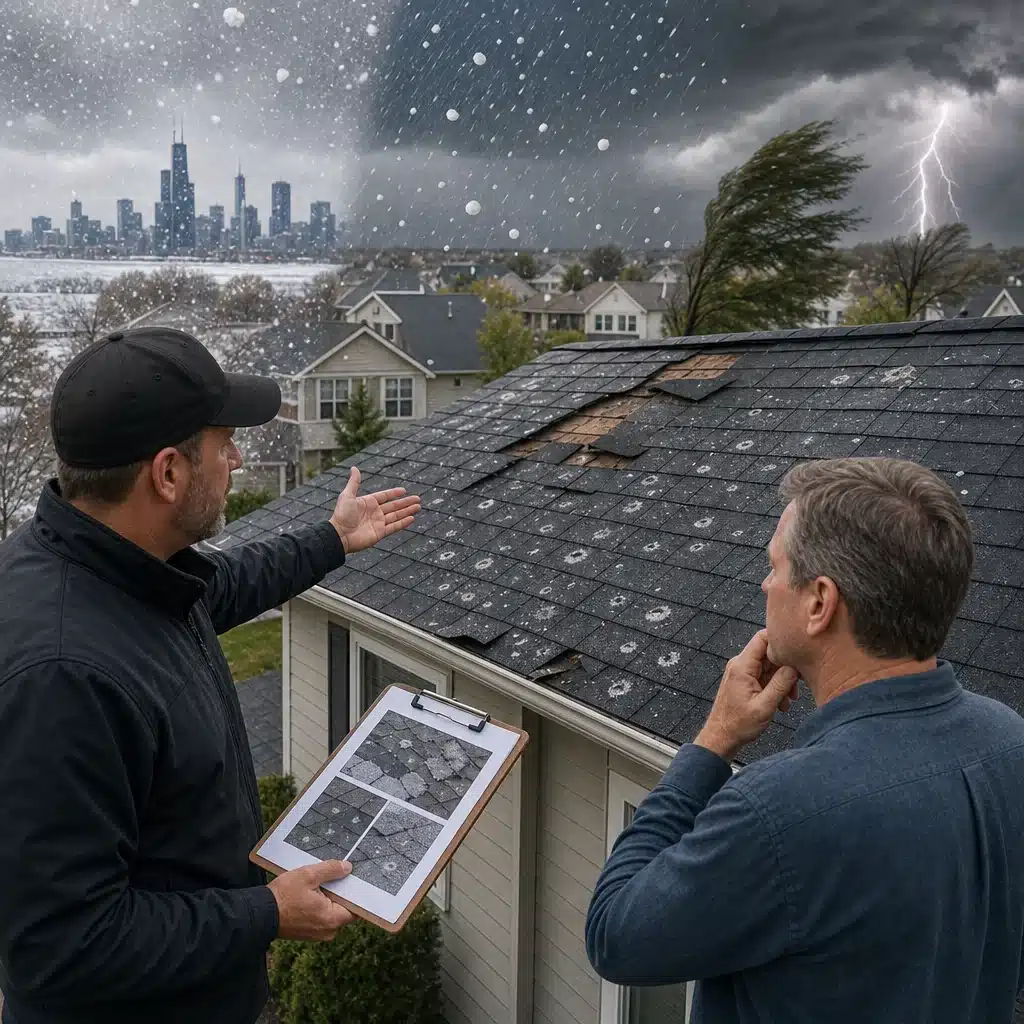
Their work typically includes:
- Reading and interpreting your specific policy, including endorsements and exclusions
- Inspecting the property and preparing an independent scope of loss
- Preparing estimates using the same software carriers rely on
- Negotiating directly with the carrier on your behalf
- Managing supplements when hidden damage is uncovered during work
In Illinois, public adjusters are licensed and regulated by the Department of Insurance. That licensing matters because it establishes accountability and sets ethical boundaries that ordinary contractors cannot legally cross when discussing claims.
Takeaway: If a contractor offers to “handle your claim” without a public adjuster license, that is a red flag. Ask to see the license number.
How Our Dual Role as Roofer and Public Adjuster Protects Your Investment
Most homeowners either hire a roofer who cannot legally negotiate the claim or a public adjuster who does not build roofs. That gap is where settlements get lost. As both a licensed roofing contractor with 35+ years of local experience and a firm with licensed public adjusters on staff, we close that gap under one roof.
What this looks like in practice:
- The scope of loss reflects real installation requirements, not generic line items
- Code upgrades, ventilation, and flashing details are priced correctly the first time
- Supplements for hidden decking damage or chimney flashing get documented on the spot
- You are not caught in the middle relaying messages between two vendors
Takeaway: When one team owns both the claim and the craftsmanship, fewer details slip through the cracks and settlements track closer to true replacement cost.
Step-by-Step: Our Chicago Roofing Insurance Claim Process
We keep the process transparent so homeowners always know where their claim stands.
- Free roof and property assessment. We inspect the roof, siding, gutters, and soft metals for storm indicators.
- Claim strategy meeting. We review your policy, deductible, and coverage type (ACV vs. RCV) before filing.
- Claim filing support. You file with your carrier while we prepare independent documentation.
- Adjuster meeting on-site. Our licensed public adjuster meets the carrier’s adjuster at your home, walks the roof together, and presents evidence.
- Scope negotiation. We reconcile the carrier’s estimate against ours line by line.
- Approved scope and material selection. Once approved, you choose shingles, DaVinci slate or shake, colors, and accessories.
- Installation. Our crews complete the work to manufacturer specifications and Illinois code.
- Supplement and depreciation recovery. We submit final invoices and pursue any recoverable depreciation owed to you.
Takeaway: Ask any contractor for their claim workflow in writing. If they cannot describe steps 4 through 8, they are not equipped to protect your settlement.
Documenting Storm, Hail, and Wind Damage the Right Way
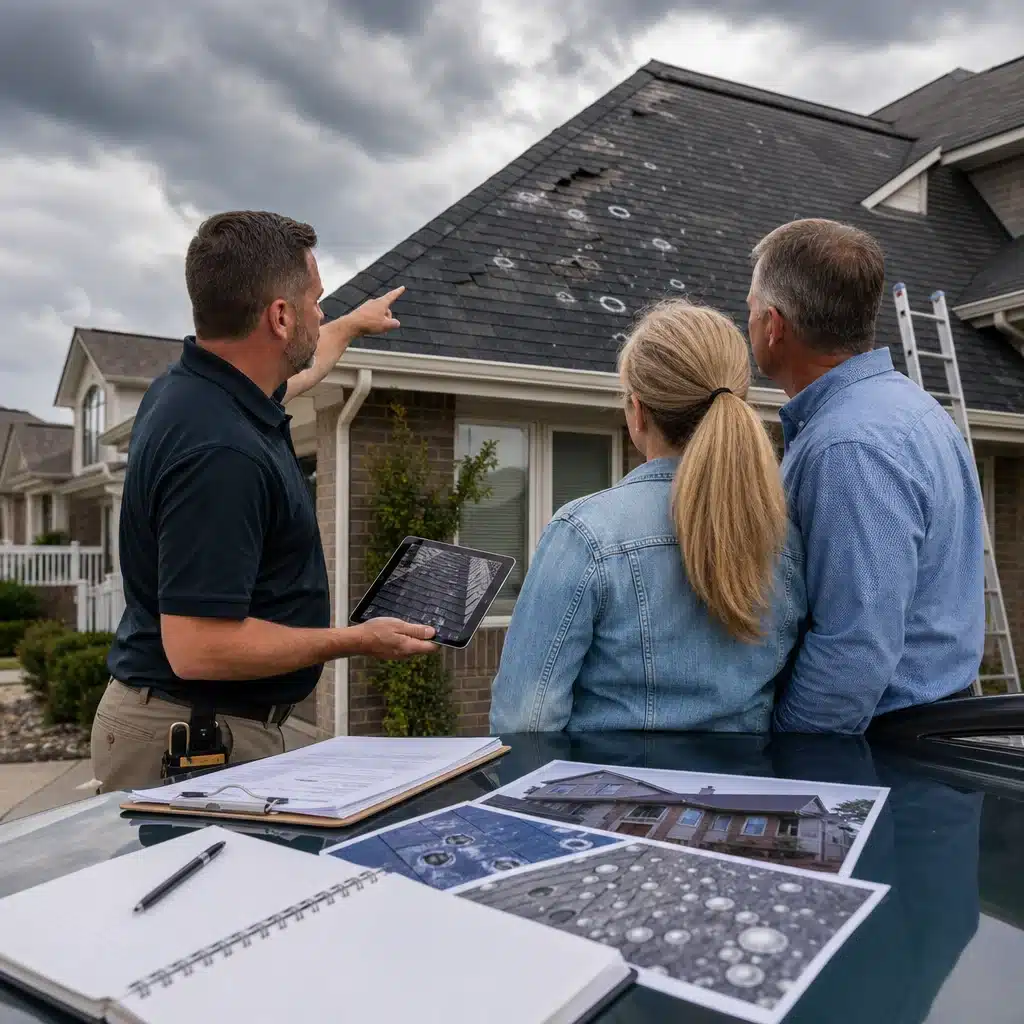
Documentation determines outcomes. A storm damage roof claim built on vague photos and generic descriptions rarely produces a full replacement. A well-documented claim usually does.
Our documentation package includes:
- Date-stamped aerial and close-up photography of every slope, ridge, valley, and penetration
- Hail impact mapping showing test squares with counts per 10×10 area
- Wind damage indicators including creased shingles, missing tabs, and lifted seals
- Soft metal evidence on gutters, downspouts, vents, and window wraps that corroborate hail
- NOAA storm reports and radar data tied to the specific date of loss
- Interior damage links where leaks connect back to exterior failure points
For hail damage insurance claim files especially, that soft-metal evidence is often the difference between approval and denial. Hail that dents an aluminum gutter did not spare your shingles.
Takeaway: Never let anyone walk your roof without a camera and a plan. If you are unsure what to photograph, call us before the carrier’s adjuster arrives.
Maximizing Your Settlement Without the Homeowner Headache
Getting fair value from a homeowners insurance roof replacement claim is less about negotiation theatrics and more about preparation. When our scope is accurate, priced to current Chicago-area labor and material costs, and supported by evidence, carriers generally settle at fair market value.
A few practices that consistently improve outcomes:
- File promptly. Most policies require notice within a reasonable time after the loss.
- Do not sign a scope you do not understand. Every line item has meaning.
- Track all communications. Save emails, note phone calls, and request written decisions.
- Pursue recoverable depreciation. Once work is complete, submit final documentation to recover the withheld amount.
- Watch your deductible. It is your responsibility, and no reputable contractor will “waive” it.
Takeaway: The homeowners who net the strongest settlements are the ones who let a qualified public adjuster for roofing handle negotiations while they focus on choosing materials and colors.
Why Chicago Homeowners Trust Our 35+ Years of Local Expertise
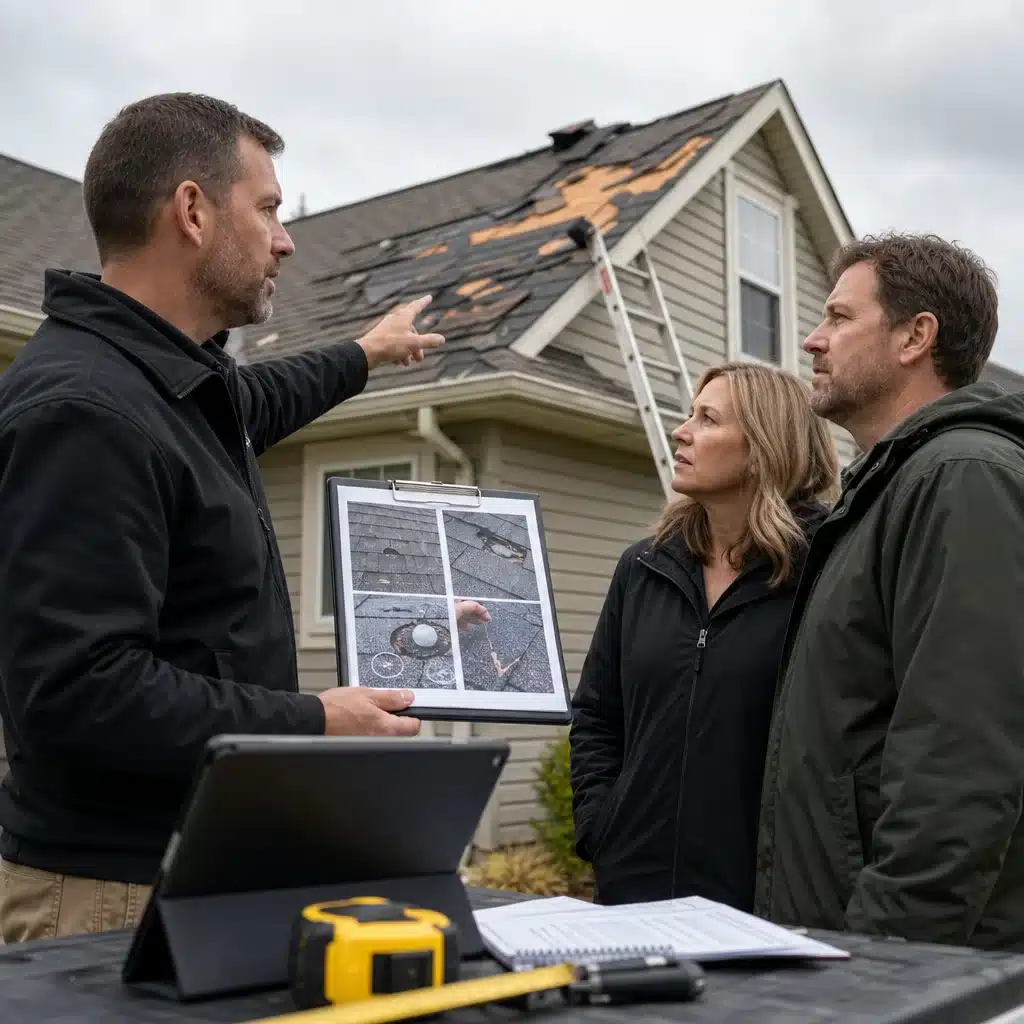
Longevity in this market is earned. We have inspected roofs across Naperville, Wheaton, Arlington Heights, Oak Park, and dozens of communities in between, through every major storm event since the late 1980s. That local memory shapes how we evaluate damage, price scopes, and communicate with carriers who know our reputation.
What sets our work apart:
- Premium installations including DaVinci synthetic slate and shake
- Full-service siding and window replacement to match roof projects
- Outdoor living construction such as decks and pergolas
- 24/7 emergency response when storms hit overnight, detailed in our storm response guide
- Manufacturer certifications that unlock extended warranties
Takeaway: Choose a contractor whose warranty will still be honored in 15 years. Local tenure is one of the best predictors.
Getting Started: Scheduling Your Free Roof and Claim Assessment
If you suspect storm damage or you already have an open claim that feels underfunded, the fastest way forward is a professional inspection. We will document conditions, review your policy, and give you a clear recommendation, whether that involves filing a new claim, disputing an existing settlement, or simply monitoring the roof for another season.
To get started:
- Call or request an appointment through our website
- Have your policy declarations page ready if possible
- Note the approximate date of the storm event if known
- Plan for about 60 to 90 minutes on-site
Roofing insurance claims in Chicago do not have to be adversarial, but they do require preparation, documentation, and a licensed advocate who understands both the shingles and the policy language. We are ready to be that advocate for your home.
Frequently Asked Questions (FAQ)
What does a licensed public adjuster do during a Chicago roofing insurance claim?
A licensed public adjuster represents you, the homeowner, rather than the insurance carrier. We review your policy, document storm or hail damage, prepare the claim estimate, and negotiate directly with your insurer to pursue a fair settlement. Because we hold both roofing and public adjusting credentials, we handle the technical and financial sides of the claim together.
How do I know if my roof has enough storm or hail damage to file a claim?
Not every dent or missing shingle qualifies, which is why we start with a free on-site assessment. We inspect shingles, flashing, vents, gutters, and soft metals for hail bruising and wind uplift, then compare our findings against your policy language. If the damage meets the threshold for a legitimate claim, we walk you through the next steps before anything is filed.
Will using a public adjuster slow down my roof replacement?
In most cases, having us manage the claim actually shortens the timeline because documentation, scope, and pricing are handled correctly the first time. We coordinate the adjuster meeting, submit accurate reports, and respond quickly to carrier requests, which reduces back-and-forth. Once the claim is approved, our roofing crews can move directly into scheduling the replacement.